Linderman Lab

Stanford University

Welcome to the Linderman Lab! We belong to the Statistics Department and the Wu Tsai Neurosciences Institute at Stanford University. Our work blends computational neuroscience, artificial intelligence, and Bayesian statistics to develop models and algorithms for complex data. Check out some of our research below, and reach out if you'd like to learn more!

Research

Our lab works across computational neuroscience, artificial intelligence, and statistics. We develop models and algorithms for neural and behavioral data, contribute to the foundations of modern AI architectures, and advance the theory and practice of Bayesian statistics.

Computational Neuroscience

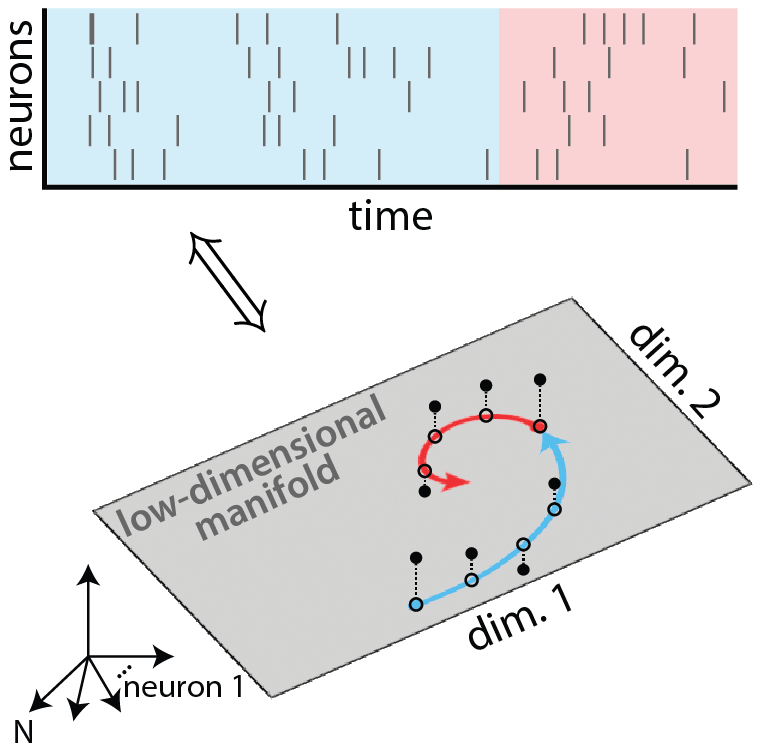
Modern recording and tracking technologies let us measure thousands of neurons and quantify behavior with unprecedented precision, but the resulting data are noisy, high-dimensional time series. We develop state space models tailored to this challenge, like the rSLDS (Linderman et al., 2017), gpSLDS (Hu et al., 2024), and Keypoint MoSeq (Weinreb et al., 2024). Working closely with experimental collaborators, we have used tools like these to study neural dynamics underlying emotional states (Nair et al., 2023; Vinograd et al., 2024), the neural basis of natural behavior (Markowitz et al., 2023), and how behavior changes throughout the lifespan (Bedbrook et al., 2025). We also build open-source software — including SSM and Dynamax (Linderman et al., 2025) — to make these tools broadly accessible.

Artificial Intelligence

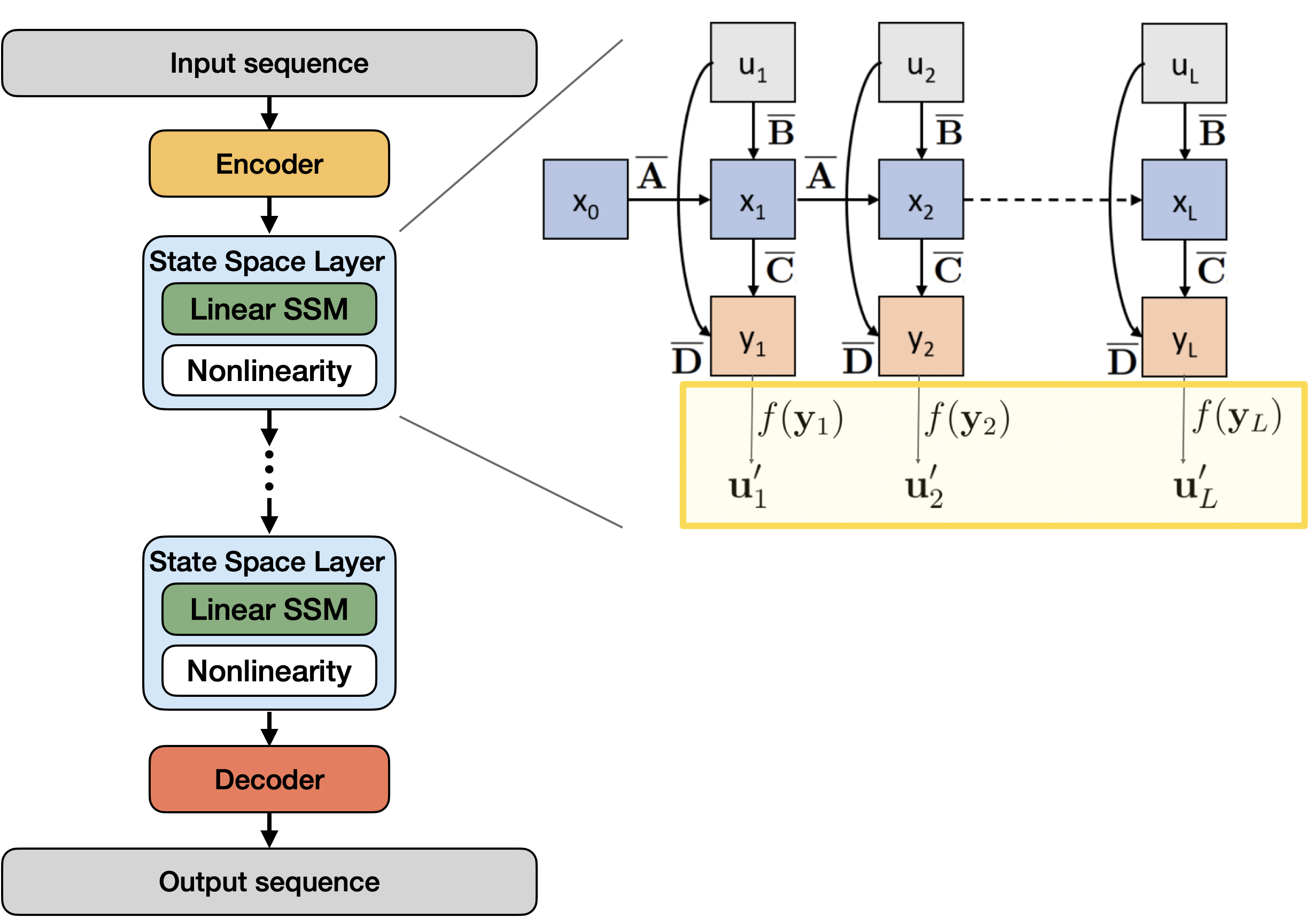
Deep state space models have seen a resurgence within machine learning, and they are now widely used for sequential data like language, audio, and video. We helped pioneer this area with S5 (Smith et al., 2023a,b), and we continue to develop theory and algorithms for parallelizing deep SSMs with nonlinear dynamics (Gonzalez et al., 2024, 2025, 2026). Beyond SSMs, we have also developed cost-efficient collaboration protocols between on-device and cloud models (Narayan et al., 2025), information-theoretic principles for agentic system design (He et al., 2026), and informed correctors for discrete diffusion models (Zhao et al., 2025).

Bayesian Statistics

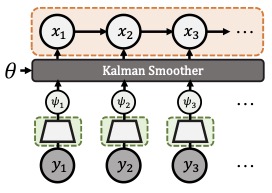
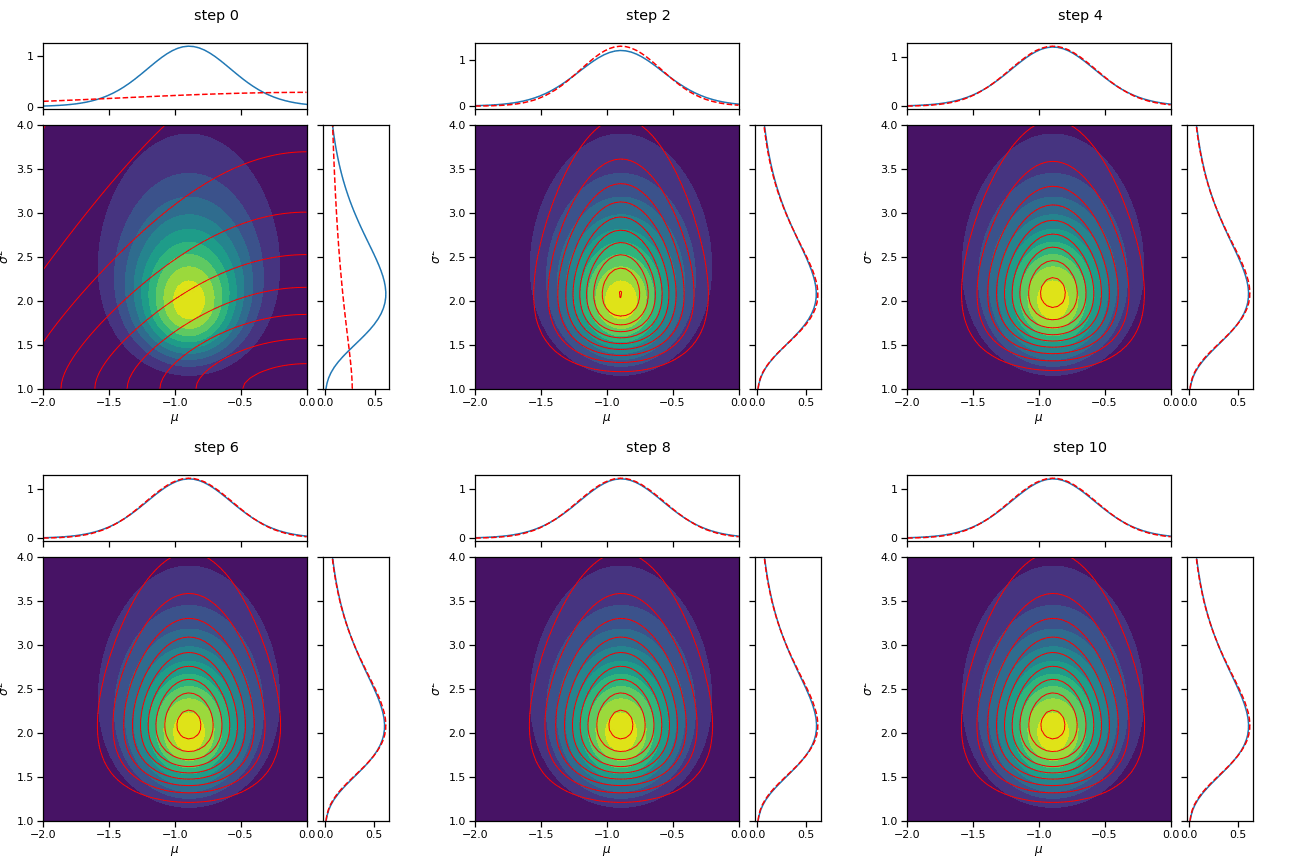
Fitting complex probabilistic models to large datasets requires inference algorithms that scale. We have developed novel methods for inference in latent stochastic differential equation models (Hu and Smith et al., 2025; Smith et al., 2026) and algorithms for parallelizing MCMC across the sequence length (Zoltowski et al., 2025). We have studied methods that blend sequential Monte Carlo and variational inference (Naesseth et al., 2018; Lawson et al., 2022, 2023), point processes like the Neyman-Scott processes (Williams et al., 2020; Wang et al., 2023) and Hawkes processes (Linderman and Adams, 2014), and structure-exploiting inference algorithms for variational autoencoders (Zhao and Linderman, 2023).

Group


Scott W. Linderman

I'm an Assistant Professor of Statistics and an Institute Scholar in the Wu Tsai Neurosciences Institute at Stanford University. I hold a courtesy appointment in Computer Science, and I'm a member of Stanford Bio-X and the Stanford AI Lab. I was a postdoctoral fellow with Liam Paninski and David Blei at Columbia University, and I completed my PhD in Computer Science at Harvard University with Ryan Adams and Leslie Valiant. I obtained my undergraduate degree in Electrical and Computer Engineering from Cornell University and spent three years as a software engineer at Microsoft prior to graduate school.

E-mail: scott.linderman@stanford.edu   CV   Google Scholar

Kanha Batra

Postdoc (Co-advised by Prof. Lisa Giocomo)

Yiqi Jiang

PhD Student (EE, co-advised by Prof. Mark Schnitzer)

Alisa Levin

PhD Student (CS, co-advised by Prof. Jaimie Henderson)

Josh Lunger

Visiting Undergraduate Researcher (from U. Toronto)

Henry Smith

PhD Student (Statistics, co-advised by Prof. Brian Trippe)


Alumni

  • Ben Antin — Research Assistant (2019-20). Now PhD Student at Columbia
  • Shaunak Bhandarkar — Undergraduate RA (2023-24). Now PhD Student at Princeton
  • Dan Biderman — Postdoc (2024-25). Now Co-Founder of Engram Lab.
  • Julia Costacurta — PhD Student (EE, 2020-2025). Now Visting Prof. at Haverford
  • Lea Duncker — Postdoc (2021-23). Now Asst. Prof. at Columbia
  • Elizabeth DuPre — Postdoc (2022-24). Now Postdoc at U. Montreal
  • Xavier Gonzalez — PhD Student (Statistics, 2020-26). Now Technical Staff at Unconventional AI
  • Amber Hu — PhD Student (Statistics, 2021-26). Now Research Scientist at Datadog
  • Maxwell Kounga — Undergraduate RA (2023-24). Now MD-PhD Student at UCSF
  • Dieterich Lawson — PhD Student (CS, 2019-23). Now Research Scientist at Google
  • Sophia Lu — Undergraduate RA (2020-21). Now PhD Student at Stanford
  • Matthew MacKay — PhD Student (Statistics, 2020-23). Now Technical Staff at Anthropic
  • Aditya Nair — Postdoc (2024-25). Now Asst. Prof. at LKCMedicine-NTU Singapore & IMCB-A*STAR
  • Blue Sheffer — PhD Student (CS, 2019-21). Now Co-Founder of School of Song
  • Jimmy Smith — PhD Student (ICME, 2019-24). Now Founding Scientist at Liquid AI
  • Andy Warrington — Postdoc (2020-23). Now Research Scientist at GE
  • Alex Williams — Postdoc (2019-21). Now Asst. Prof. at NYU and Research Scientist at the Flatiron Institute
  • Libby Zhang — PhD Student (EE, 2019-25). Now Shanahan Fellow at the Allen Institute and U. Washington
  • Yixiu Zhao — PhD Student (Applied Physics, 2020-25). Now Research Scientist at Basis Research Institute
  • David Zoltowski — Postdoc (2022-26). Now Research Scientist at Google DeepMind

Teaching

STAT 320: Machine Learning Methods for Neural Data Analysis

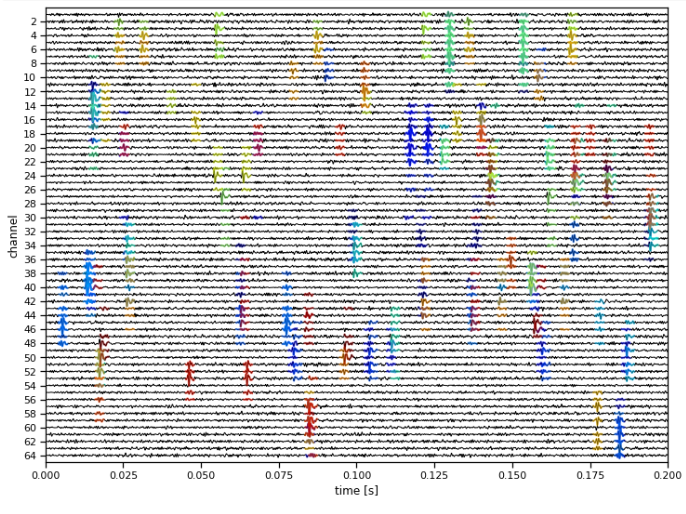
This course is organized around a series of coding labs. Each week, we introduce the theory behind a state-of-the-art method for neural data analysis. Then, in the lab, we develop a minimal version of that method from scratch, in Python. The methods include: spike sorting and calcium deconvolution methods for extracting relevant signals from raw data; markerless tracking methods for estimating animal pose in behavioral videos; generalized linear models and deep learning models for neural encoding and decoding; and state space models for analysis of high-dimensional neural and behavioral time-series.
Online Textbook (Still in development): https://slinderman.github.io/ml4nd

STAT 305B: Applied Statistics II

This is a course about models and algorithms for discrete data. We cover models ranging from generalized linear models to sequential latent variable models, autoregressive models, and transformers. On the algorithm side, we cover a few techniques for convex optimization, as well as approximate Bayesian inference algorithms like MCMC and variational inference. I think the best way to learn these concepts is to implement them from scratch, so coding is a big focus of this course. By the end, you will have a strong grasp of classical techniques as well as modern methods for modeling discrete data.
Course Reader: https://slinderman.github.io/stats305b

STAT 305C: Applied Statistics III

This course is about probabilistic modeling and (approximate) Bayesian inference algorithms for high dimensional data. Topics include multivariate Gaussian models, probabilistic graphical models, hierarchical Bayesian models, MCMC and variational Bayesian inference, principal components analysis, factor analysis, matrix completion, topic modeling, state space models, variational autoencoders, Gaussian processes, and point processes. Each week pairs a family of models with an approximate inference algorithm. The course involves extensive Python programming using PyTorch and applied statistical analyses of real datasets.
Course Reader: https://slinderman.github.io/stats305c

Publications

2026

  1. Smith, H. D., Trippe, B. L., & Linderman, S. W. (2026). Closing the Approximation Gap in Simulation-free Latent SDEs. ArXiv 2606.16138.
    arXiv
  2. Lotlikar, A., Tanoh, I. C., Vasireddy, P. K., Lanpouthakoun, A., Sommeling, M. A., Vilkhu, R., Phillips, A. J., Sher, A., Litke, A., Linderman, S. W., Chichilnisky, E. J., & Mitra, S. (2026). Learning Biophysical Models of Large-Scale Multineuronal Data To Enable Precise Neurostimulation. Forty-Third International Conference on Machine Learning.
    Paper
  3. Gonzalez, X., Buchanan, E. K., Lee, H. D., Liu, J. W., Wang, K. A., Zoltowski, D. M., Kozachkov, L., Re, C., & Linderman, S. (2026). A Unifying Framework for Parallelizing Sequential Models with Linear Dynamical Systems. Transactions on Machine Learning Research.
    Paper arXiv Code
  4. Bedbrook, C. N., Nath, R. D., Zhang, L., Linderman, S. W., Brunet, A., & Deisseroth, K. (2026). Lifelong behavioral screen reveals an architecture of vertebrate aging. Science, 391(6790), eaea9795.
    Paper bioRxiv
  5. Lee, H. D., Jha, A., Clarke, S. E., Silvernagel, M. P., Nuyujukian, P., & Linderman, S. W. (2026). Stiefel Manifold Dynamical Systems for Tracking Representational Drift. BioRxiv. https://doi.org/10.64898/2026.03.07.710319
    bioRxiv Code
  6. Linderman, R., Cowan, N., Chen, Y., & Linderman, S. (2026). A Bayesian Nonparametric Perspective on Mahalanobis Distance for Out of Distribution Detection. Transactions on Machine Learning Research.
    Paper arXiv Code
  7. Weinreb, C., Kannan, L. T., Newman-Boulle, A., Sainburg, T., Gillis, W. F., Plotnikoff, A., Makowska, S., Pearl, J. E., Osman, M. A. M., Linderman, S. W., & Datta, S. R. (2026). Spontaneous behavior is a succession of self-directed tasks. Neuron. https://doi.org/https://doi.org/10.1016/j.neuron.2025.11.021
    Paper
  8. Zhang, Y., He, L., Fan, C., Liu, T., Yu, H., Le, T., Li, J., Linderman, S. W., Duncker, L., Willett, F. R., Mesgarani, N., & Paninski, L. (2026). Decoding Inner Speech with an End-to-End Brain-to-Text Neural Interface. The Fourteenth International Conference on Learning Representations.
    Paper arXiv
  9. He, S., Narayan, A., Khare, I. S., Linderman, S. W., Ré, C., & Biderman, D. (2026). An Information Theoretic Perspective on Agentic System Design. The Fourteenth International Conference on Learning Representations.
    Paper arXiv
  10. Levin, A. D., Avansino, D. T., Kamdar, F. B., Card, N. S., Wairagkar, M., Jacques, B. G., Jude, J. J., Iacobacci, C., Lacayo, B. E., Bechefsky, P. H., Nason-Tomaszewski, S. R., Deo, D. R., Hochberg, L. R., Rubin, D. B., Williams, Z. M., Brandman, D. M., Stavisky, S. D., AuYong, N., Pandarinath, C., … Willett, F. R. (2026). Cross-brain transfer of high-performance intracortical speech and handwriting BCIs. BioRxiv. https://doi.org/10.64898/2026.01.12.699110
    bioRxiv

2025

  1. Nair, A., Vinograd, A., Liu, M., Mountoufaris, G., Linderman, S. W., & Anderson, D. J. (2025). The neural computation of affective internal states in the hypothalamus: A dynamical systems perspective. Neuron, 113(23), 3887–3907.
    Paper
  2. Beller, A., Xu, Y., Siegel, M. H., Grant, S., Brown, A. S., Fränken, J.-P., Tenenbaum, J., Linderman, S. W., & Gerstenberg, T. (2025). Multimodal inference through mental simulation. PsyArXiv. https://doi.org/10.31234/osf.io/x2tj9_v1
    PsyArXiv
  3. Xiao, S. A., Chen, C. C., Horvath, P., Tsai, V., Cardenas, V. M., Biderman, D., Deng, F., Li, Y., Linderman, S. W., Dulac, C., & Luo, L. (2025). Concerted actions of distinct serotonin neurons orchestrate female pup care behavior. BioRxiv. https://doi.org/10.1101/2025.07.31.667987
    bioRxiv
  4. Bukwich, M., Campbell, M. G., Zoltowski, D., Kingsbury, L., Tomov, M. S., Stern, J., Kim, H. G. R., Drugowitsch, J., Linderman, S. W., & Uchida, N. (2025). Competitive integration of time and reward explains value-sensitive foraging decisions and frontal cortex ramping dynamics. Neuron. https://doi.org/https://doi.org/10.1016/j.neuron.2025.07.008
    Paper bioRxiv
  5. Tanoh, I. C., Deistler, M., Macke, J. H., & Linderman, S. W. (2025). Identifying multi-compartment Hodgkin-Huxley models with high-density extracellular voltage recordings. Advances in Neural Information Processing Systems (NeurIPS).
    Paper arXiv Code
  6. Gonzalez*, X., Kozachkov*, L., Zoltowski, D. M., Clarkson, K. L., & Linderman, S. W. (2025). Predictability Enables Parallelization of Nonlinear State Space Models. Advances in Neural Information Processing Systems (NeurIPS).
    arXiv
  7. Hu*, A., Smith*, H., & Linderman, S. W. (2025). SING: SDE Inference via Natural Gradients. Advances in Neural Information Processing Systems (NeurIPS).
    arXiv Code
  8. Zoltowski*, D. M., Wu*, S., Gonzalez, X., Kozachkov, L., & Linderman, S. W. (2025). Parallelizing MCMC Across the Sequence Length. Advances in Neural Information Processing Systems (NeurIPS).
    arXiv Code
  9. Saad-Falcon*, J., Buchanan*, E. K., Chen*, M. F., Huang, T.-H., McLaughlin, B., Bhathal, T., Zhu, S., Athiwaratkun, B., Sala, F., Linderman, S. W., Mirhoseini, A., & Re, C. (2025). Weaver: Shrinking the Generation-Verification Gap by Scaling Compute for Verification. Advances in Neural Information Processing Systems (NeurIPS).
    arXiv
  10. Jiang, Y., Sheng, K., Gao, Y., Buchanan, E. K., Shikano, Y., Woo, S. J., Zhao, Y., Kim, T. H., Dinc, F., Linderman, S. W., & Schnitzer, M. (2025). Extracting task-relevant preserved dynamics from contrastive aligned neural recordings. Advances in Neural Information Processing Systems (NeurIPS). Selected for Spotlight Presentation
    Paper bioRxiv Code
  11. Zhao, Y., Shi, J., Chen, F., Druckmann, S., Mackey, L., & Linderman, S. W. (2025). Informed Correctors for Discrete Diffusion Models. Advances in Neural Information Processing Systems (NeurIPS).
    arXiv
  12. Narayan*, A., Biderman*, D., Eyuboglu*, S., May, A., Linderman, S., Zou, J., & Re, C. (2025). Minions: Cost-efficient Collaboration Between On-device and Cloud Language Models. International Conference on Machine Learning (ICML).
    arXiv Code
  13. Versteeg, C., McCart, J. D., Ostrow, M., Zoltowski, D. M., Washington, C. B., Driscoll, L., Codol, O., Michaels, J. A., Linderman, S. W., Sussillo, D., & others. (2025). Computation-through-Dynamics Benchmark: Simulated datasets and quality metrics for dynamical models of neural activity. BioRxiv, 2025–2002.
    bioRxiv
  14. Linderman, S. W., Chang, P., Harper-Donnelly, G., Kara, A., Li, X., Duran-Martin, G., & Murphy, K. (2025). Dynamax: A Python package for probabilistic state space modeling with JAX. Journal of Open Source Software, 10(108), 7069. https://doi.org/10.21105/joss.07069
    Paper Code
  15. Vloeberghs, R., Urai, A. E., Desender, K., & Linderman, S. W. (2025). A Bayesian Hierarchical Model of Trial-to-Trial Fluctuations in Decision Criterion. PLoS Computational Biology. https://doi.org/10.1371/journal.pcbi.1013291
    Paper bioRxiv Code

2024

  1. Willett, F. R., Li, J., Le, T., Fan, C., Chen, M., Shlizerman, E., Chen, Y., Zheng, X., Okubo, T. S., Benster, T., Lee, H. D., Kounga, M., Buchanan, E. K., Zoltowski, D. M., Linderman, S. W., & Henderson, J. M. (2024). Brain-to-Text Benchmark ’24: Lessons Learned. CoRR.
    arXiv
  2. Kendrick, R. M., Linderman, S., & Owen, S. F. (2024). Transcriptomically-measured gene expression predicts physiological variation across single neurons in humans and mice. BioRxiv, 2024–2008.
    bioRxiv
  3. Friedmann, D., Gonzalez, X., Moses, A., Watts, T., Degleris, A., Ticea, N., Song, J. H., Datta, S. R., Linderman^*, S. W., & Luo^*, L. (2024). Concerted modulation of spontaneous behavior and time-integrated whole-brain neuronal activity by serotonin receptors. BioRxiv. https://doi.org/10.1101/2024.08.02.606282
    bioRxiv
  4. Vinograd^*, A., Nair^*, A., Kim, J., Linderman, S. W., & Anderson, D. J. (2024). Causal evidence of a line attractor encoding an affective state. Nature. https://doi.org/10.1038/s41586-024-07915-x
    Paper bioRxiv
  5. Mountoufaris, G., Nair, A., Yang, B., Kim, D.-W., Vinograd, A., Kim, S., Linderman, S. W., & Anderson, D. J. (2024). A line attractor encoding a persistent internal state requires neuropeptide signaling. Cell. https://doi.org/https://doi.org/10.1016/j.cell.2024.08.015
    Paper
  6. Liu^*, M., Nair^*, A., Coria, N., Linderman, S. W., & Anderson, D. J. (2024). Encoding of female mating dynamics by a hypothalamic line attractor. Nature. https://doi.org/10.1038/s41586-024-07916-w
    Paper bioRxiv
  7. Hu, A., Zoltowski, D., Nair, A., Anderson, D., Duncker, L., & Linderman, S. W. (2024). Modeling Latent Neural Dynamics with Gaussian Process Switching Linear Dynamical Systems. Advances in Neural Information Processing Systems (NeurIPS).
    Paper arXiv
  8. Costacurta, J. C., Bhandarkar, S., Zoltowski, D. M., & Linderman, S. W. (2024). Structured flexibility in recurrent neural networks via neuromodulation. Advances in Neural Information Processing Systems (NeurIPS). https://doi.org/10.1101/2024.07.26.605315
    Paper bioRxiv
  9. Gonzalez, X., Warrington, A., Smith, J. T. H., & Linderman, S. W. (2024). Towards Scalable and Stable Parallelization of Nonlinear RNNs. Advances in Neural Information Processing Systems (NeurIPS). https://doi.org/10.48550/arXiv.2407.19115
    Paper arXiv
  10. Gershman, S. J., Assad, J. A., Datta, S. R., Linderman, S. W., Sabatini, B. L., Uchida, N., & Wilbrecht, L. (2024). Explaining dopamine through prediction errors and beyond. Nature Neuroscience, 1–11.
    Paper
  11. Weinreb, C., Pearl, J. E., Lin, S., Osman, M. A. M., Zhang, L., Annapragada, S., Conlin, E., Hoffmann, R., Makowska, S., Gillis, W. F., Jay, M., Ye, S., Mathis, A., Mathis, M. W., Pereira, T., Linderman^*, S. W., & Datta^*, S. R. (2024). Keypoint-MoSeq: parsing behavior by linking point tracking to pose dynamics. Nature Methods, 21(7), 1329–1339. https://doi.org/10.1038/s41592-024-02318-2
    Paper bioRxiv Code
  12. Smékal, J., Smith, J. T. H., Kleinman, M., Biderman, D., & Linderman, S. W. (2024). Towards a theory of learning dynamics in deep state space models. ICML 2024 Workshop on Next Generation of Sequence Modeling Architectures. Selected for Spotlight Presentation
    arXiv

2023

  1. Smith, J. T. H., Mello, S. D., Kautz, J., Linderman, S. W., & Byeon, W. (2023). Convolutional State Space Models for Long-Range Spatiotemporal Modeling. Thirty-Seventh Conference on Neural Information Processing Systems.
    arXiv Code
  2. Lawson, D., Li, M. Y., & Linderman, S. W. (2023). NAS-X: Neural Adaptive Smoothing via Twisting. Thirty-Seventh Conference on Neural Information Processing Systems.
    arXiv Code
  3. Lee, H. D., Warrington, A., Glaser, J. I., & Linderman, S. W. (2023). Switching Autoregressive Low-rank Tensor Models. Thirty-Seventh Conference on Neural Information Processing Systems.
    arXiv Code
  4. Hennig, J., Pinto, S. A. R., Yamaguchi, T., Linderman, S. W., Uchida, N., & Gershman, S. J. (2023). Emergence of belief-like representations through reinforcement learning. PLoS Computational Biology. https://doi.org/10.1101/2023.04.04.535512
    bioRxiv
  5. Wang, Y., Degleris, A., Williams, A. H., & Linderman, S. W. (2023). Spatiotemporal Clustering with Neyman-Scott Processes via Connections to Bayesian Nonparametric Mixture Models. Journal of the American Statistical Association.
    Paper arXiv Code
  6. Zhao, Y., & Linderman, S. W. (2023). Revisiting Structured Variational Autoencoders. International Conference on Machine Learning (ICML).
    Paper arXiv Code
  7. Smith, J. T. H., Warrington, A., & Linderman, S. W. (2023). Simplified State Space Layers for Sequence Modeling. International Conference on Learning Representations (ICLR). Selected for Oral Presentation (top 5% of accepted papers, top 1.5% of all submissions)
    Paper arXiv Code
  8. Markowitz, J., Gillis, W., Jay, M., Wood, J., Harris, R., Cieszkowski, R., Scott, R., Brann, D., Koveal, D., Kuila, T., Weinreb, C., Osman, M., Pinto, S. R., Uchida, N., Linderman, S. W., Sabatini, B., & Datta, S. R. (2023). Spontaneous behavior is structured by reinforcement without exogenous reward. Nature. https://doi.org/https://doi.org/10.1038/s41586-022-05611-2
    Paper
  9. Nair, A., Karigo, T., Yang, B., Ganguli, S., Schnitzer, M. J., Linderman, S. W., Anderson, D. J., & Kennedy, A. (2023). An approximate line attractor in the hypothalamus encodes an aggressive state. Cell, 186(1), 178–193.
    Paper bioRxiv

2022

  1. Lawson, D., Raventos, A., Warrington, A., & Linderman, S. W. (2022). SIXO: Smoothing Inference with Twisted Objectives. Advances in Neural Information Processing Systems. Selected for Oral Presentation
    Paper arXiv Code
  2. Costacurta, J. C., Duncker, L., Sheffer, B., Gillis, W., Weinreb, C., Markowitz, J. E., Datta, S. R., Williams, A. H., & Linderman, S. W. (2022). Distinguishing discrete and continuous behavioral variability using warped autoregressive HMMs. Advances in Neural Information Processing Systems.
    Paper bioRxiv
  3. Beller, A., Xu, Y., Linderman, S. W., & Gerstenberg, T. (2022). Looking into the past: Eye-tracking mental simulation in physical inference. Proceedings of the Annual Meeting of the Cognitive Science Society, 44.
    Paper arXiv
  4. Beron, C. C., Neufeld, S. Q., Linderman^*, S. W., & Sabatini^*, B. L. (2022). Mice exhibit stochastic and efficient action switching during probabilistic decision making. Proceedings of the National Academy of Sciences, 119(15), e2113961119. https://doi.org/10.1073/pnas.2113961119
    Paper bioRxiv
  5. Lin, A., Witvliet, D., Hernandez-Nunez, L., Linderman, S. W., Samuel, A. D. T., & Venkatachalam, V. (2022). Imaging whole-brain activity to understand behaviour. Nature Reviews Physics, 1–14.
    Paper
  6. Linderman, S. W. (2022). Weighing the evidence in sharp-wave ripples. Neuron, 110(4), 568–570. https://doi.org/https://doi.org/10.1016/j.neuron.2022.01.036
    Paper Code

2021

  1. Williams, A. H., & Linderman, S. W. (2021). Statistical neuroscience in the single trial limit. Current Opinion in Neurobiology, 70, 193–205. https://doi.org/https://doi.org/10.1016/j.conb.2021.10.008
    Paper arXiv
  2. Smith, J. T. H., Linderman, S. W., & Sussillo, D. (2021). Reverse engineering recurrent neural networks with Jacobian switching linear dynamical systems. Advances in Neural Information Processing Systems (NeurIPS).
    Paper arXiv Code
  3. Williams, A. H., Kunz, E., Kornblith, S., & Linderman, S. W. (2021). Generalized Shape Metrics on Neural Representations. Advances in Neural Information Processing Systems (NeurIPS).
    Paper arXiv Code
  4. Yu, X., Creamer, M. S., Randi, F., Sharma, A. K., Linderman, S. W., & Leifer, A. M. (2021). Fast deep neural correspondence for tracking and identifying neurons in C. elegans using semi-synthetic training. Elife, 10, e66410.
    Paper arXiv
  5. Low, I. I. C., Williams, A. H., Campbell, M. G., Linderman, S. W., & Giocomo, L. M. (2021). Dynamic and reversible remapping of network representations in an unchanging environment. Neuron.
    Paper bioRxiv
  6. Zhang, L., Marshall, J. D., Dunn, T., Ölveczky, B., & Linderman, S. W. (2021). Animal pose estimation from video data with a hierarchical von Mises-Fisher-Gaussian model. Proceedings of the International Conference on Artificial Intelligence and Statistics (AISTATS).
    Paper

2020

  1. Mittal, A., Linderman, S. W., Paisley, J., & Sajda, P. (2020). Bayesian recurrent state space model for rs-fMRI. Machine Learning for Health (ML4H) Workshop at NeurIPS 2020.
    arXiv
  2. Williams, A. H., Degleris, A., Wang, Y., & Linderman, S. W. (2020). Point process models for sequence detection in high-dimensional neural spike trains. Advances in Neural Information Processing Systems (NeurIPS). Selected for Oral Presentation (1.1% of all submissions)
    Paper arXiv Code
  3. Glaser, J. I., Whiteway, M., Cunningham, J. P., Paninski, L., & Linderman, S. W. (2020). Recurrent switching dynamical systems models for multiple interacting neural populations. Advances in Neural Information Processing Systems (NeurIPS).
    Paper bioRxiv Code
  4. Tansey, W., Li, K., Zhang, H., Linderman, S. W., Rabadan, R., Blei, D. M., & Wiggins, C. H. (2020). Dose-response modeling in high-throughput cancer drug screenings: An end-to-end approach. Biostatistics.
    Paper arXiv
  5. Zoltowski, D. M., Pillow, J. W., & Linderman, S. W. (2020). A general recurrent state space framework for modeling neural dynamics during decision-making. Proceedings of the International Conference on Machine Learning (ICML).
    Paper arXiv Code
  6. Johnson*, R. E., Linderman*, S. W., Panier, T., Wee, C. L., Song, E., Herrera, K. J., Miller, A., & Engert, F. (2020). Probabilistic models of larval zebrafish behavior reveal structure on many scales. Current Biology, 30(1), 70–82.
    Paper bioRxiv

2019

  1. Sun*, R., Linderman*, S. W., Kinsella, I., & Paninski, L. (2019). Scalable Bayesian inference of dendritic voltage via spatiotemporal recurrent state space models. Advances in Neural Information Processing Systems (NeurIPS). Selected for Oral Presentation (0.5% of all submissions)
    Paper Code
  2. Apostolopoulou, I., Linderman, S. W., Miller, K., & Dubrawski, A. (2019). Mutually regressive point processes. Advances in Neural Information Processing Systems (NeurIPS).
    Paper Code
  3. Schein, A., Linderman, S. W., Zhou, M., Blei, D., & Wallach, H. (2019). Poisson-randomized gamma dynamical systems. Advances in Neural Information Processing Systems (NeurIPS).
    Paper arXiv Code
  4. Batty^*, E., Whiteway^*, M., Saxena, S., Biderman, D., Abe, T., Musall, S., Gillis, W., Markowitz, J., Churchland, A., Cunningham, J., Linderman^\dagger, S. W., & Paninski^\dagger, L. (2019). BehaveNet: nonlinear embedding and Bayesian neural decoding of behavioral videos. Advances in Neural Information Processing Systems (NeurIPS).
    Paper Code
  5. Linderman, S. W., Nichols, A. L. A., Blei, D. M., Zimmer, M., & Paninski, L. (2019). Hierarchical recurrent state space models reveal discrete and continuous dynamics of neural activity in C. elegans. BioRxiv. https://doi.org/10.1101/621540
    bioRxiv
  6. Nassar, J., Linderman, S. W., Park, M., & Bugallo, M. (2019). Tree-structured locally linear dynamics model to uproot Bayesian neural data analysis. Computational and Systems Neuroscience (Cosyne) Abstracts.
  7. Raju, R. V., Li, Z., Linderman, S. W., & Pitkow, X. (2019). Inferring implicit inference. Computational and Systems Neuroscience (Cosyne) Abstracts.
  8. Glaser, J., Linderman, S. W., Whiteway, M., Perich, M., Dekleva, B., Miller, L., & Cunningham, L. P. J. (2019). State space models for multiple interacting neural populations. Computational and Systems Neuroscience (Cosyne) Abstracts.
  9. Markowitz, J., Gillis, W., Murmann, J., Linderman, S. W., Sabatini, B., & Datta, S. (2019). Resolving the neural mechanisms of reinforcement learning through new behavioral technologies. Computational and Systems Neuroscience (Cosyne) Abstracts.
  10. Linderman, S. W., Sharma, A., Johnson, R. E., & Engert, F. (2019). Point process latent variable models of larval zebrafish behavior. Computational and Systems Neuroscience (Cosyne) Abstracts.
  11. Nassar, J., Linderman, S. W., Bugallo, M., & Park, I. M. (2019). Tree-Structured Recurrent Switching Linear Dynamical Systems for Multi-Scale Modeling. International Conference on Learning Representations (ICLR).
    Paper arXiv

2018

  1. Sharma, A., Johnson, R. E., Engert, F., & Linderman, S. W. (2018). Point process latent variable models of freely swimming larval zebrafish. Advances in Neural Information Processing Systems (NeurIPS).
    Paper Code
  2. Markowitz, J. E., Gillis, W. F., Beron, C. C., Neufeld, S. Q., Robertson, K., Bhagat, N. D., Peterson, R. E., Peterson, E., Hyun, M., Linderman, S. W., Sabatini, B. L., & Datta, S. R. (2018). The Striatum Organizes 3D Behavior via Moment-to-Moment Action Selection. Cell. https://doi.org/doi: 10.1016/j.cell.2018.04.019
    Paper
  3. Linderman, S. W., Nichols, A., Blei, D. M., Zimmer, M., & Paninski, L. (2018). Hierarchical recurrent models reveal latent states of neural activity in C. elegans. Computational and Systems Neuroscience (Cosyne) Abstracts.
  4. Markowitz, J. E., Gillis, W. F., Beron, C. C., Neufeld, S. Q., Robertson, K., Bhagat, N. D., Peterson, R. E., Peterson, E., Hyun, M., Linderman, S. W., Sabatini, B. L., & Datta, S. R. (2018). Complementary Direct and Indirect Pathway Activity Encodes Sub-Second 3D Pose Dynamics in Striatum. Computational and Systems Neuroscience (Cosyne) Abstracts.
  5. Johnson*, R. E., Linderman*, S. W., Panier, T., Wee, C., Song, E., Herrera, K., Miller, A. C., & Engert, F. (2018). Revealing multiple timescales of structure in larval zebrafish behavior. Computational and Systems Neuroscience (Cosyne) Abstracts.
  6. Mena, G. E., Belanger, D., Linderman, S. W., & Snoek, J. (2018). Learning Latent Permutations with Gumbel-Sinkhorn Networks. International Conference on Learning Representations (ICLR).
    Paper Code
  7. Linderman, S. W., Mena, G. E., Cooper, H., Paninski, L., & Cunningham, J. P. (2018). Reparameterizing the Birkhoff Polytope for Variational Permutation Inference. Proceedings of the 21st International Conference on Artificial Intelligence and Statistics (AISTATS).
    Paper arXiv
  8. Naesseth, C. A., Linderman, S. W., Ranganath, R., & Blei, D. M. (2018). Variational Sequential Monte Carlo. Proceedings of the 21st International Conference on Artificial Intelligence and Statistics (AISTATS).
    Paper arXiv

2017

  1. Buchanan, E. K., Lipschitz, A., Linderman, S. W., & Paninski, L. (2017). Quantifying the behavioral dynamics of C. elegans with autoregressive hidden Markov models. Workshop on Worm’s Neural Information Processing at the 31st Conference on Neural Information Processing Systems.
    Paper
  2. Mena, G. E., Linderman, S. W., Belanger, D., Snoek, J., Cunningham, J. P., & Paninski, L. (2017). Toward Bayesian permutation inference for identifying neurons in C. elegans. Workshop on Worm’s Neural Information Processing at the 31st Conference on Neural Information Processing Systems.
    Paper
  3. Linderman, S. W., & Johnson, M. J. (2017). Structure-Exploiting Variational Inference for Recurrent Switching Linear Dynamical Systems. IEEE International Workshop on Computational Advances in Multi-Sensor Adaptive Processing.
    Paper
  4. Linderman, S. W., & Blei, D. M. (2017). Comment: A Discussion of “Nonparametric Bayes Modeling of Populations of Networks.” Journal of the American Statistical Association, 112(520), 1543–1547.
    Paper Code
  5. Linderman, S. W., & Gershman, S. J. (2017). Using computational theory to constrain statistical models of neural data. Current Opinion in Neurobiology, 46, 14–24.
    Paper bioRxiv Code
  6. Linderman, S. W., Miller, A. C., Adams, R. P., Blei, D. M., Johnson, M. J., & Paninski, L. (2017). Neuro-behavioral Analysis with Recurrent switching linear dynamical systems. Computational and Systems Neuroscience (Cosyne) Abstracts.
  7. Linderman*, S. W., Johnson*, M. J., Miller, A. C., Adams, R. P., Blei, D. M., & Paninski, L. (2017). Bayesian learning and inference in recurrent switching linear dynamical systems. Proceedings of the 20th International Conference on Artificial Intelligence and Statistics (AISTATS).
    Paper Slides Talk Code
  8. Naesseth, C. A., Ruiz, F. J. R., Linderman, S. W., & Blei, D. M. (2017). Reparameterization Gradients through Acceptance-Rejection Sampling Algorithms. Proceedings of the 20th International Conference on Artificial Intelligence and Statistics (AISTATS). Best Paper Award.
    Paper Blog Post Code

2016

  1. Chen, Z., Linderman, S. W., & Wilson, M. A. (2016). Bayesian Nonparametric Methods For Discovering Latent Structures Of Rat Hippocampal Ensemble Spikes. IEEE Workshop on Machine Learning for Signal Processing.
    Paper Code
  2. Elibol, H. M., Nguyen, V., Linderman, S. W., Johnson, M. J., Hashmi, A., & Doshi-Velez, F. (2016). Cross-Corpora Unsupervised Learning of Trajectories in Autism Spectrum Disorders. Journal of Machine Learning Research, 17(133), 1–38.
    Paper
  3. Linderman, S. W., Adams, R. P., & Pillow, J. W. (2016). Bayesian latent structure discovery from multi-neuron recordings. Advances in Neural Information Processing Systems (NIPS).
    Paper Code
  4. Linderman, S. W. (2016). Bayesian methods for discovering structure in neural spike trains [PhD thesis]. Harvard University. Leonard J. Savage Award for Outstanding Dissertation in Applied Bayesian Methodology from the International Society for Bayesian Analysis
    Thesis Code
  5. Linderman, S. W., Johnson, M. J., Wilson, M. A., & Chen, Z. (2016). A Bayesian nonparametric approach to uncovering rat hippocampal population codes during spatial navigation. Journal of Neuroscience Methods, 263, 36–47.
    Paper Code
  6. Linderman, S. W., Tucker, A., & Johnson, M. J. (2016). Bayesian Latent State Space Models of Neural Activity. Computational and Systems Neuroscience (Cosyne) Abstracts.

2015

  1. Linderman*, S. W., Johnson*, M. J., & Adams, R. P. (2015). Dependent Multinomial Models Made Easy: Stick-Breaking with the Pólya-gamma Augmentation. Advances in Neural Information Processing Systems (NIPS), 3438–3446.
    Paper arXiv Code
  2. Linderman, S. W., & Adams, R. P. (2015). Scalable Bayesian Inference for Excitatory Point Process Networks. ArXiv Preprint ArXiv:1507.03228.
    arXiv Code
  3. Linderman, S. W., Adams, R. P., & Pillow, J. W. (2015). Inferring structured connectivity from spike trains under negative-binomial generalized linear models. Computational and Systems Neuroscience (Cosyne) Abstracts.
  4. Johnson, M. J., Linderman, S. W., Datta, S. R., & Adams, R. P. (2015). Discovering switching autoregressive dynamics in neural spike train recordings. Computational and Systems Neuroscience (Cosyne) Abstracts.

2014

  1. Linderman, S. W., Stock, C. H., & Adams, R. P. (2014). A framework for studying synaptic plasticity with neural spike train data. Advances in Neural Information Processing Systems (NIPS), 2330–2338.
    Paper arXiv
  2. Linderman, S. W. (2014). Discovering Latent States of the Hippocampus with Bayesian Hidden Markov Models. CBMM Memo 024: Abstracts of the Brains, Minds, and Machines Summer School.
    Paper
  3. Linderman, S. W., & Adams, R. P. (2014). Discovering Latent Network Structure in Point Process Data. Proceedings of the International Conference on Machine Learning (ICML), 1413–1421.
    Paper arXiv Talk Code
  4. Linderman, S. W., Stock, C. H., & Adams, R. P. (2014). A framework for studying synaptic plasticity with neural spike train data. Annual Meeting of the Society for Neuroscience.
    Paper
  5. Nemati, S., Linderman, S. W., & Chen, Z. (2014). A Probabilistic Modeling Approach for Uncovering Neural Population Rotational Dynamics. Computational and Systems Neuroscience (Cosyne) Abstracts.